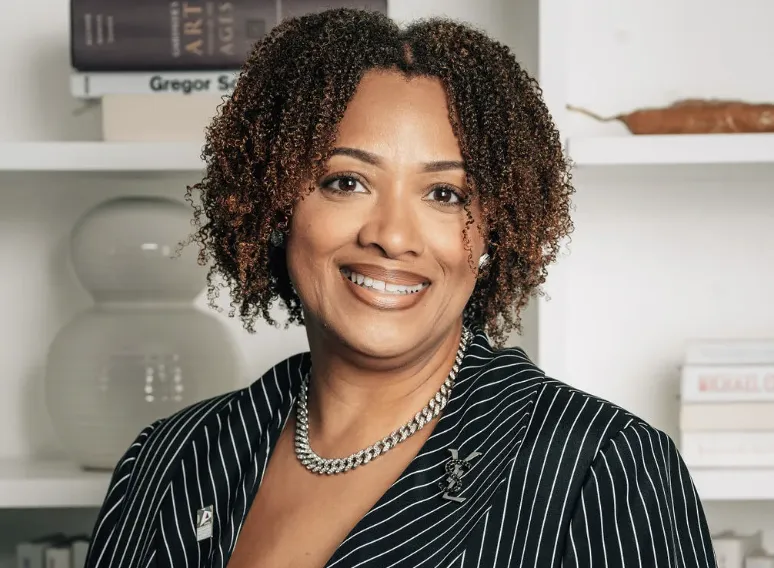
Seen, Heard, and Affirmed: Baretta Massey’s Vision for a School That Serves Its Community
At Alain Locke Elementary School, Principal Baretta Massey is redefining what it means to lead by listening deeply to families, cultivating authentic partnerships, and teaching children how to claim their voice and power.
When Principal Baretta Massey (2024 Neubauer Fellow, Cohort 8) first arrived at Alain Locke Elementary School, she did not come with a master plan to lead a community school. When Massey began her principalship, her focus was not on the label of a community school but on the urgent work in front of her. “We had a lot to do around instruction and shaping the climate and culture of the building,” she explains. “What being a community school meant was not the focus.”
That changed abruptly in the months before COVID, when Massey attended a meeting that would reshape her understanding of her leadership role as a community school—and Locke’s responsibility to its neighborhood. A community school is a public school that serves as a neighborhood hub—integrating academics with health and social services, family engagement, and community partnerships to remove barriers to learning and support the success of students, families, and the surrounding community. The meeting centered on the planned closure and redevelopment of West Park, the public housing complex behind the school where many of Locke’s students lived. “I remember sitting there thinking that the majority of our kids come from West Park,” she says. “And I kept asking myself, ‘How could you be the school in the center of this and not know this is happening?’” That moment crystallized something fundamental for Massey. “It felt like things were just happening to people in our school community,” she says. “And if people aren’t given power and voice, this will keep happening over and over again.”
The realization marked the beginning of her work to transform Alain Locke into a place not just of learning, but of advocacy, information, and collective agency. What emerged was a guiding principle that now anchors the school’s identity: students and parents are seen, heard, and affirmed. “Our families know us. They trust us,” Massey explains. “And once families started coming to us as their primary source of information, we had a responsibility to understand the systems impacting them—and then help them navigate those systems. Our role is to listen to what they are telling us and then to make it happen” The work required building new information pipelines, elevating parents’ voices, and teaching students to question, analyze, and advocate.
Health partnerships became a first natural extension of that work. What began as basic screenings with Main Line Health quickly evolved. “While we provide basic screenings for our families, what I found is everything kept coming back to food.” Nutrition became the foundation for health programming, leading to weekly fresh‑produce distribution, cooking classes, a student‑written cookbook, and eventually a community garden and hydroponics lab created in partnership with Neubauer Fellow Mandy Manna. Today, students help grow components of their own meals and learn seed‑to‑table sustainability alongside university and nonprofit partners.
Central to that work was a critical reassessment of partnerships. At the time, Locke technically had dozens of preexisting partners. “When I began, I was told we had 41 partners,” Massey says. “But no one could tell me what they actually did.” She made the decision to step back and rebuild intentionally. “I needed partners who aligned with our vision—who believed in seeing, hearing, and affirming families—and who were willing to work alongside us, not around us.”
Today, Locke works with a tight core of 12 to 14 partners who meet regularly, listen directly to students and families, and adapt their work based on expressed needs. One of Massey’s most consequential decisions came through strong leadership and direct action. “Too many times ideas can get stuck in planning,” Massey explains. “You have to take action to innovate. Once I’ve asked and there’s no answer, that’s permission for me to move,” she says. “My families need support now.” The directness that defines her leadership style has already set the path for the future; new therapeutic services are taking shape, alongside blended case management and ongoing health partnerships.
For Massey, the work of a community school cannot be rushed or replicated by checklist. “It took me three to four years to build real partnerships,” she says. “You can’t cookie‑cutter this: there isn’t a blueprint to follow. If that’s not what the community has asked for, then we don’t need it.” She resists the label even now. “I don’t know if I believe I’m a community school,” she reflects. “I just believe I’m a school that serves its community.” When colleagues ask for a blueprint, her answer is simple. “It has to be in your heart. I can’t teach you how to listen to your families.” At Alain Locke, listening has become the work—and the legacy.